A Japanese finance company ran a ChatGPT pilot and measured a 954% return before it scaled the tool to the whole company. That is roughly ten dollars back for every dollar spent, and the number only mattered because they measured it first. Meanwhile, Delaware floated a plan that would let AI agents run entire businesses with no human officer on record.
CONSUMER FINANCEHow Did Credit Saison's ChatGPT Pilot Hit 954% ROI?
A measured ChatGPT pilot returned 954% ROI, about $10.54 back per dollar, before Credit Saison scaled it companywide.

Credit Saison, a major Japanese consumer-finance company, ran a pilot of ChatGPT Enterprise (the business version of ChatGPT that keeps company data private and under IT control) and measured a 954% return on investment before rolling it out companywide.
The interesting part is not the headline number, it's the order of operations. Instead of buying licenses for everyone and hoping, they started with a contained group, had leaders use it themselves, and tracked the value employees got against what the pilot cost. A 954% ROI means about $10.54 of measured benefit for every dollar spent, from everyday work like drafting, summarizing, and analysis. Once the pilot proved out, leaders and employees became the people who drove adoption outward, which is usually where these programs stall.
Worth remembering: this figure is reported by OpenAI and Credit Saison on a vendor page, and ROI on knowledge work depends heavily on how you count hours saved. The repeatable lesson isn't the percentage, it's that they measured a small group before scaling.
How Did DXC Turn a Days-Long Claims Backlog Into Minutes?
DXC cut insurance claims document backlogs from days to minutes by having Claude read and organize each file first.
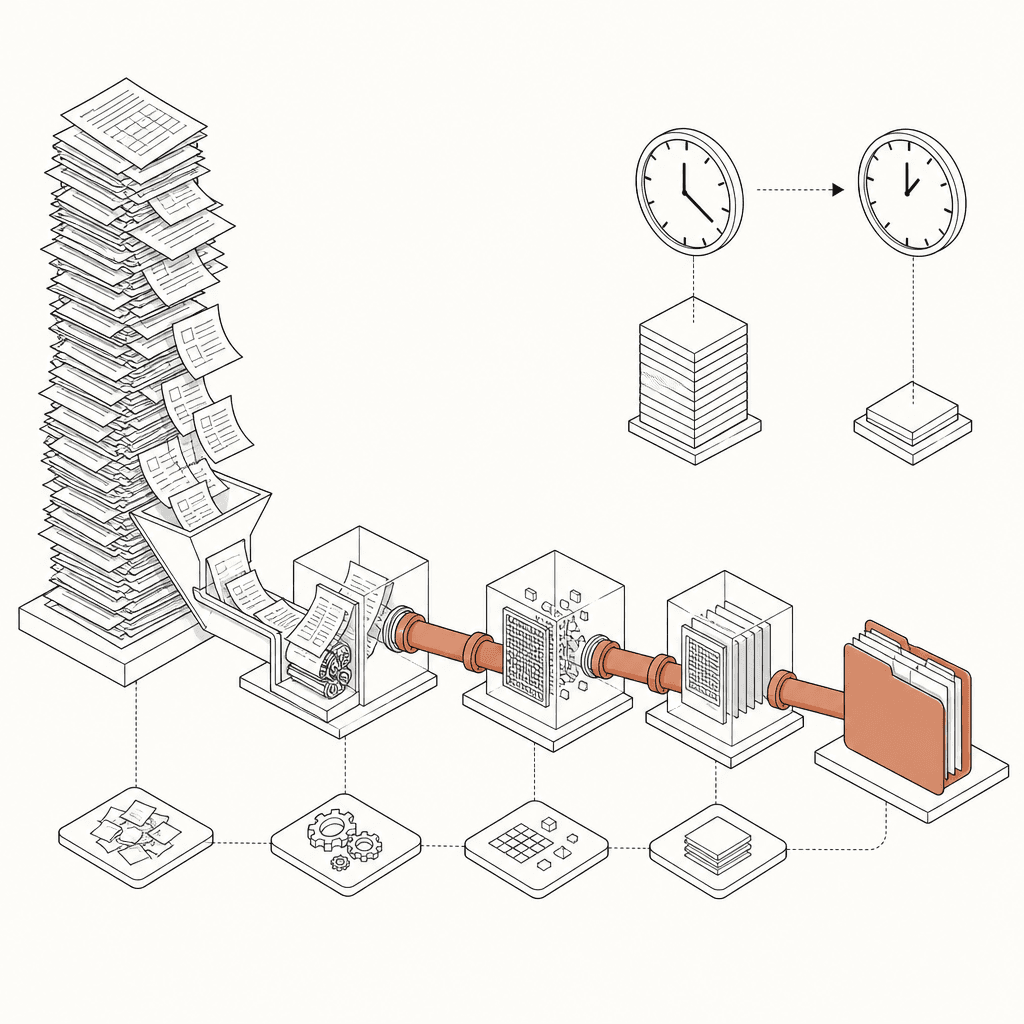
DXC Technology, a global IT services firm, built a document system on Anthropic's Claude Platform (the developer toolkit for building apps on the Claude AI model) that cut insurance claims document backlogs from days down to minutes.
Here's the work it replaced. Processing a claim means reading a stack of submitted documents, medical notes, forms, invoices, correspondence, pulling out the facts that decide the payout, and routing the case to the right place. Done by hand, those documents pile up into a backlog measured in days, which is exactly the kind of invisible delay that frustrates customers and ties up staff on sorting rather than judgment. DXC pointed Claude at that pile to read, extract the key details, and summarize each file, so a human handler opens a case that's already organized instead of a raw envelope of PDFs.
This is a vendor-published story with no date, so treat the days-to-minutes figure as DXC's own. The mechanism is the takeaway: the bottleneck wasn't deciding claims, it was reading them.
Could an AI Agent Legally Run a Whole Business?
Delaware's plan would let a company run with zero humans legally at the helm, raising who's liable for a reckless agent.

Delaware lawmakers floated a plan that would let AI agents legally operate entire companies, with no human officer required on record, the state where most US businesses are incorporated.
How it would work: an LLC (a standard company structure) could be set up to be run by AI agents making the day-to-day decisions, rather than a named human manager. That sounds like science fiction, but Delaware's corporate law is the template much of American business runs on, so a change there ripples everywhere. The catch that has critics worried is liability. US Rep. James Comer warned the structure could let owners "evade liability for reckless AI" by pointing to the machine when something goes wrong, since there's no human at the helm to hold responsible.
This is a proposal, not law, so nothing changes today. But it's a real signal of where the ground is shifting: the question is no longer whether an agent can do the work, it's who's accountable when it does.
No human at the helm
SEARCHWhy Is Google Packing More Ads Into AI Search?
Google's quarterly cash flow fell to -$9.06 billion, and it's adding more ads inside AI search answers to recover.
Google told investors its AI-powered search earns less money than the old list of blue links, and it's responding by putting more ads directly inside AI answers, as the quarter's cash flow swung to negative $9.06 billion.
The reason is mechanical. When Google answers a question right at the top with an AI summary, people click through to other sites, and to ads, far less often. Fewer clicks means less ad revenue per search, even if the answer is better. Google's fix is to weave ad placements into the AI responses themselves, so the summary that used to send you elsewhere now carries sponsored results inside it.
For any operator who relies on search to get found, this is the part worth watching. The free clicks that used to come from ranking well are getting squeezed as the answer box absorbs the attention, and the space that's left is increasingly pay-to-play. It's a reminder that the channels you don't own can change the rules on you overnight.